The announcement came out of the blue, from Blue, on Wednesday.
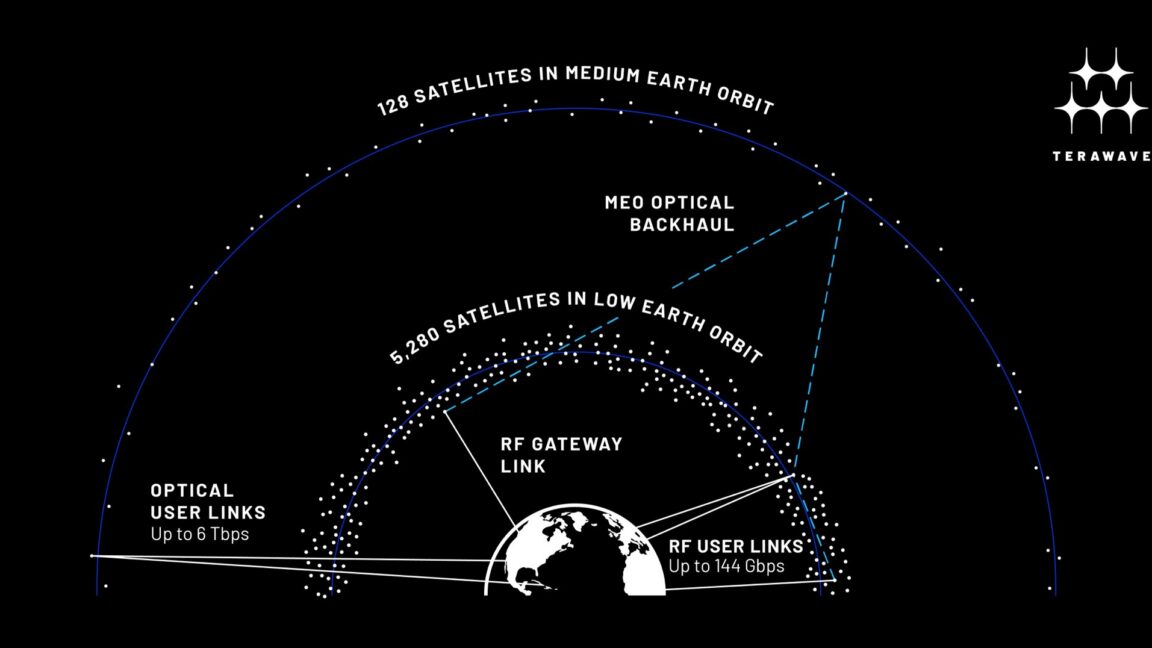
The space company founded by Jeff Bezos, Blue Origin, said it was developing a new megaconstellation named TeraWave to deliver data speeds of up to 6Tbps anywhere on Earth. The constellation will consist of 5,408 optically interconnected satellites, with a majority in low-Earth orbit and the remainder in medium-Earth orbit.
The satellites in low-Earth orbit will provide up to 144Gbps through radio spectrum, whereas those in medium-Earth orbit will provide higher data rates through optical links.
“This provides the reliability and resilience needed for real-time operations and massive data movement,” Blue Origin’s chief executive, Dave Limp, said on social media. “It also provides backup connectivity during outages, keeping critical operations running. Plus, the ability to scale on demand and rapidly deploy globally while maintaining performance.”
Going for the enterprise market
Unlike other megaconstellations, including SpaceX’s Starlink, Blue Origin’s new constellation will not serve consumers or try to provide direct-to-cell communications. Rather, TeraWave will seek to serve “tens of thousands” of enterprise, data center, and government users who require reliable connectivity for critical operations.
The announcement was surprising for several reasons, but it may also represent a shrewd business decision.
It was surprising because Bezos’ other company, Amazon, has already spent more than half a decade developing its own megaconstellation, now known as Amazon Leo, which is presently authorized to deploy 3,236 satellites into low-Earth orbit. This service is intended to compete with Starlink, both through customer terminals and by providing services such as in-flight Wi-Fi.
However, the emergence of increased data needs from AI data centers and other operations must have convinced Bezos that Blue Origin should enter the competition for lucrative enterprise customers—an area in which Amazon Leo is also expected to compete.
Sources have said that Blue Origin has also begun preliminary work on orbital data centers. It is possible that, ultimately, some elements from orbital data centers, TeraWave, and Amazon Leo are combined in some fashion.
Blue already has a lot on its plate
In a news release, Blue Origin said it would begin deployment of the TeraWave constellation in the fourth quarter of 2027. That will be a challenge both in satellite development and the company’s effort to ramp up the cadence of its New Glenn launch vehicle. The rocket has flown twice, successfully executing a first-stage landing in November. But there are already many customers lined up for the rocket, including dozens of launches for Amazon Leo.
Due to delays in developing New Glenn and other rockets, Amazon Leo has already had to launch a handful of missions on SpaceX’s Falcon 9 rocket.
One industry concern about Blue Origin is that it has taken on too many responsibilities too quickly—a large rocket, two different lunar landers, a space station, a crew capsule, the Blue Ring spacecraft, a Mars orbiter, and more projects. This has led to a competition within the company for resources and, at times, a seeming lack of focus. Adding TeraWave to the mix represents a major new initiative that will also require an extraordinary amount of effort to bring to market.
The TeraWave program is one of the first new initiatives to be launched by a new division within Blue Origin known as Emerging Systems, which is intended to be a “new strategic initiative driving innovation across advanced aerospace technologies.” It is led by an electrical engineer named Lindo St. Angel, who joined Blue Origin in November after working in various roles at Amazon for a decade and a half.

Originally published at Ars Technica