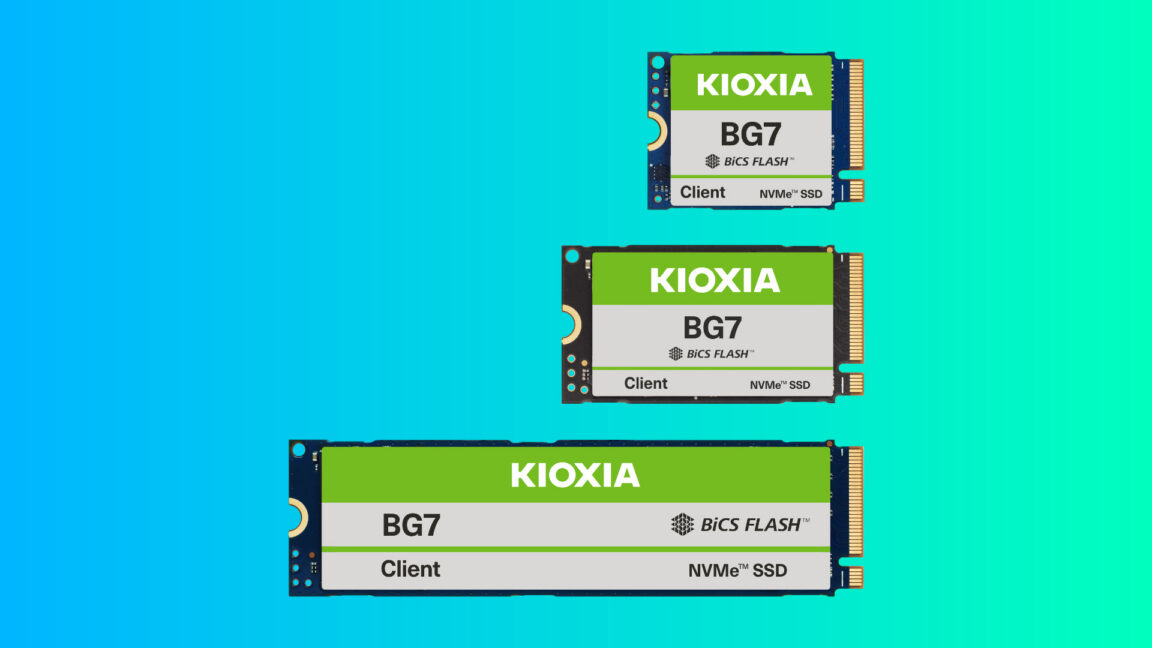
The companies that make RAM and flash memory chips are enjoying record profits because of the AI-induced memory crunch—and they’re also indicating that they don’t expect conditions to improve much if at all in 2026. And while RAM kits have been hit the fastest and hardest by shortages and price increases, we shouldn’t expect SSD pricing to improve any time soon, either.
That’s the message from Shunsuke Nakato (via PC Gamer), managing director of the memory division of Kioxia, the Japanese memory company that was spun off from Toshiba at the end of the 2010s. Nakato says that Kioxia’s manufacturing capacity is sold out through the rest of 2026, driving the market for both enterprise and consumer SSDs to a “high-end and expensive phase.”
“There is a sense of crisis that companies will be eliminated the moment they stop investing in AI, so they have no choice but to continue investing,” said Nakato, as reported by the Korean-language publication Digital Daily. Absent a big change in the demand for generative AI data centers, that cycle of investments will keep prices high for the foreseeable future.
Nakato notes that Kioxia was attempting to increase its manufacturing capacity to meet the elevated demand, saying that it was taking steps to improve yields at its factory in Yokkaichi and that Kioxia expected another factory in Kitakami to begin “full-scale mass production” this year.
As we’ve seen during several chip shortages this decade, it takes time for chip shortages to abate because it takes years to build new factories and get them producing useful numbers of usable chips. Companies are also sometimes cautious about adding new capacity too quickly, lest market conditions change in the interim and leave them with piles of expensive memory that they have to discount heavily to sell.
Our recent retail research has shown that price increases have been a bit more extreme for higher-capacity drives, at least so far—both the increases and the cost-per-gigabyte have been more extreme for 2TB and 4TB SSDs than for 1TB models. But regardless of the size of the drive, prices seem unlikely to come down any time soon.
For desktop users looking for storage upgrades, it’s worth looking into whether your PC has additional M.2 storage slots that can accommodate additional storage without making you replace the drive you have already. If it’s huge, 100+ GB modern game downloads that are devouring your drive space, Steam and most other PC game storefronts make it relatively easy to add more drives and to offload games to a secondary drive. Some larger gaming laptops also include a secondary M.2 slot, though this will vary from model to model, and some of them may require a shorter M.2 2240 SSD rather than a full-length M.2 2280 drive.
These secondary M.2 slots are sometimes slower than the primary slot, for technical reasons—sometimes one M.2 slot uses higher-speed PCI Express lanes built into the CPU, while others use lower-speed PCIe lanes provided by the chipset. But any reasonably modern PCIe 3.0 or 4.0 drive will feel fast enough for most things most of the time and will be preferable to using external storage or relying on slow SD or microSD cards.

Originally published at Ars Technica